Have I told you how much I hate these people? - Mike Malloy. It is every thinking person’s responsibility not to side with his or her executioners. - Albert Camus. Popular democracy anywhere threatens fascism everywhere. - The Scallion. A fascist junta of neocons using George W. Bush as its shill has taken over America by bloodless coup. What will it take for us to stage a revolution and take our country back? - Dot Calm. Drive a hybrid. Leave a lighter footprint on the planet. - Dot Calm.
Like Granny D, I have watched my own beloved country change, and I am angry beyond words about what I see. I grew up seeing America as the equivalent of the movie good guy, the hero in the white hat who came to the rescue of those in need around the world. I have watched in silent horror as the corporations, the captains and the kings of industry, used a comparatively small outlay of cash to buy the Republicans to use as their shills. George W. Bush is the puppet cowboy-king of shills, the proverbial emperor with no clothes. Every day, I watch these evil men legalize, legitimize, and institutionalize robbing the poor to pay the rich. They are carving up America like a giant carcass and doling out choice chunks of its meat to themselves and their cronies. Since the Democrats have been sipping at the same corporate teat where the Republicans have been gorging for the past generation, the fascists are free to do their worst; there is no longer any opposition. There is no one left to stand up for the rights of the American people, the Constitution, or the democracy, which I fear will be replaced by a fascist dictatorship in my lifetime. Wake up, America: we need a REVOLUTION NOW!
Sadly, it's no surprise that trump and the republicans voted as one to destroy us. Yes, I was hoping some would grow consciences, but, sadly, it's no surprise they all voted to kill us all.
"I wonder how rapidly MAGA would abandon their positions if we did this"
I've had the same idea, but the creator Tom Powell stitches puts it so much more eloquently: let's give everyone who votes for Democrats blue cards, and everyone who votes for republicans red cards. Then you get exactly and only the benefits you voted for according to the color of your card. Blue card? Congratulations--you get ACA, Medicare, Medicaid, Social Security, SNAP, high-quality free public education, free public libraries, due process, decent roads and infrastructure, clean energy, science and evidence-based governance, democracy, living wages, and clean, safe, high-quality air, food, medications, and water. Red card? Congratulations--you get none of these; plus, you get exactly the day you voted for the rest of us to have.
"You should see how they treat their women" (short)
Iran? Iraq? Afghanistan? They've got nothing on how profoundly the good ol' United States of America hates women. We literally ignored a pregnant nurse's headaches, sent her home to die, and then enslaved her brain-dead body to incubate her fetus, callously disregarding her family's wishes, until her body decayed around the severely pre-term fetus, which we then cut out of her. Oh, and we stuck the family with the bill--enough to bankrupt anyone but musk and bezos. Pro-life, amirite?
"Let's talk about Trump not knowing about Medicaid cuts...."
madame president* trump reportedly didn't know that her "big beautiful bill" --HER SIGNATURE LEGISLATION--slashes Medicaid. Um, that's not exactly some kind of compassionate flex. Which is more worrying: the fact that trump is too demented, senile, stupid, ignorant, and out of touch to KNOW what's in HER legislation, or the fact that she's too rich, sociopathic, and narcissistic to give a flying fuck?
"Oprah Winfrey at Jeff Bezos' Wedding Should Teach Us One Thing: Tax the Rich"
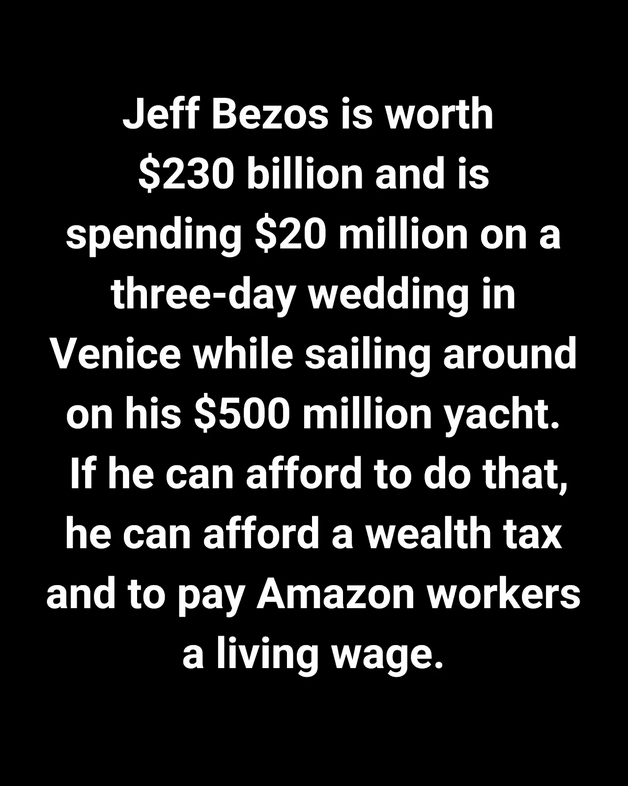
Angela and I agree: there is no such thing as a "good billionaire," and billionaires should be outlawed into oblivion. We need a wealth cap. The obscene wealth people like oprah have does nothing but corrupt--alas, she was never a nice person to begin with. She's a great self-promoter, but she never truly cared about the women's causes she pretended to support. She also platformed lunatics like mehmet oz. "Environmentalist" (or just mental) leonardo di caprio also attended bezos's bloated nuptials--even though he wishes you didn't know about it. Our lives, our safety, our country, our democracy--all just tawdry, insignificant little playthings to the stupid, parasitic rich.
"Let's talk about Trump's trillions in debt...."
trump added $7.8 TRILLION in DEBT to the U.S. budget IN THE FIRST TERM and is now responsible for $11 TRILLION in DEBT--that's almost ONE THIRD of our current debt. trump intends to add EVEN MORE DEBT this term, especially now that the trump-republican nightmarish "big beautiful" fascist oligarch tax cut, Medicaid-killing bill passed. NONE of this is "deficit reduction" or "fiscal responsibility," so don't be duped by republican lies. republicans fiscally responsible? - my left ass cheek! The only fiscal responsibility republicans have is for destroying this nation, its economy, and its people. What does 1 trillion look like? Belle gives some visuals.
"Let's talk about the dollar, Trump, and you...."
"trump alone can kill it." I'm talking about the American economy. My money is on trump not stopping until country goes bankrupt. Why? Because trump is doing everything possible to weaken the dollar, which, among other things, means that imports are going to cost even more on top of the already stupid trump tariffs.
"Musk Escalates His War On Trump Making Nuclear Threat Against All Republicans"
We all know that leona musk hates us ordinary folk. But it's nonetheless satisfying to see her turn her wrath on people who actually deserve it: miss trump and her republicans. Time to pop some popcorn!
From Pete Buttigieg:
"It shouldn't get lost that just today, Senate Republicans have voted to close nursing homes, close rural hospitals, and cut food stamp benefits for children and veterans."
I'll add: house and senate republicans need to pay for their own health care, for their own security, for trump's weekly golf vacations, and for trump's security out of their own pockets. They can afford it!
Crappy 4th of July. Fuck trump & every republican--may they have the exact lives they want for all of us, and may we all be spared. This is NOT a day to celebrate.
CALL YOUR REPRESENTATIVES NOW--VOTE "NO" on the trump "big beautiful" pro-billionaire fascist, anti-American tax bill!!!!!
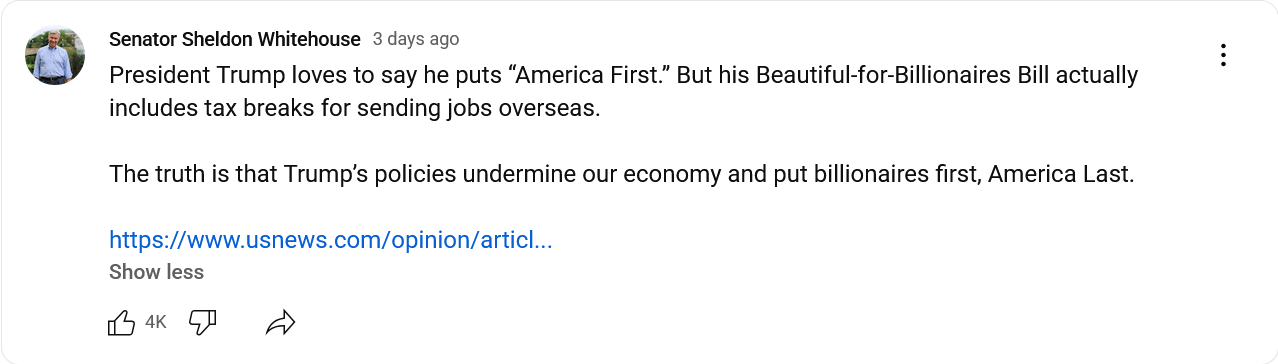
The nightmare trump-republican-fascist-billionaire "big beautiful bill," which would severely limit access to medical care for all Americans by decimating Medicaid, has passed the Senate thanks to madame vice president* jessica donaldina vance's tie-breaking vote (Alaskans, never forget: lisa murkowski threw you under the bus with the rest of us).
But we're not dead yet: the Senate added amendments that may not sit well with republicans in the House.
So CALL YOUR REPRESENTATIVES NOW! Tell them to VOTE NO on this horrific bill that will disrupt the lives of every single one of us--including the billionaires it's intended to benefit.
Call your elected people in Congress NOW to STOP the trump-republican "big beautiful" tax bill--the life you save may be your own!
Medicaid by any other name in your state is STILL MEDICAID--and republicans are dying to cut it to give YOUR paid benefits to billionaires. If you're in Oklahoma and on SoonerCare or in Tennessee and on TennCare, congratulations--YOU'RE ON MEDICAID. Medicaid subsidizes medical costs for ALL Americans and keeps everyone's hospitals OPEN. CALL YOUR ELECTED CONGRESSPEOPLE AND SENATORS AND TELL THEM TO VOTE NO on the "big beautiful bill"--aka trump-republicans' murderous budget. (Again, pardon the short.)
"How We're Trying to Stop the Big Ugly Bill"
musk is LYING to you yet again: Democrats are doing everything possible to STOP the "big beautiful bill." They've forced it to be read out loud so that republicans can't deny they know what's in it. They're forcing a vote-a-rama on amendments to mitigate the harms to the American people--and republicans are voting against every amendment and FOR every harm. So don't you DARE say that both parties are the same! republicans are trying to kill you; Democrats are trying to save you!
"Do people realize what happens if Trump tax bill passes?"
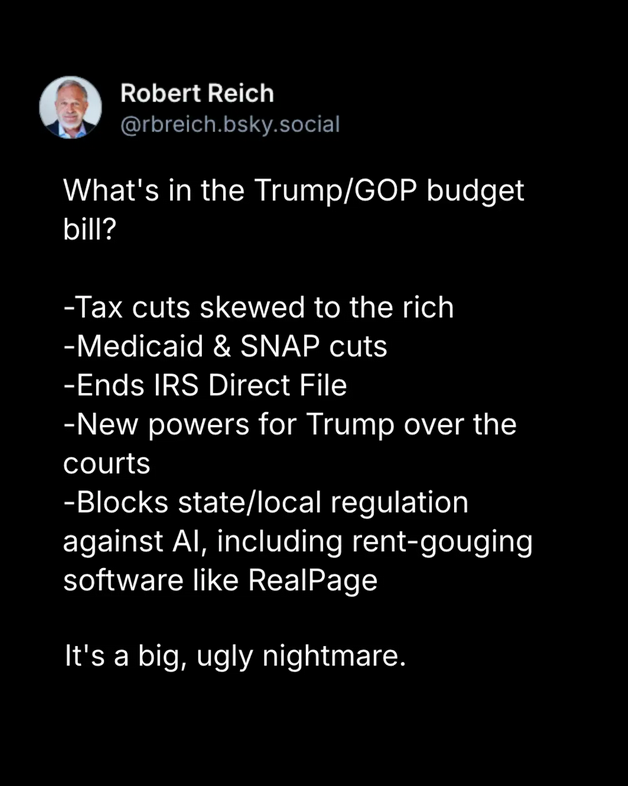
There's a lot more ugly in the "big beautiful bill" than even "just" killing Medicaid and, along with it, millions of Americans. Too many Americans are sleeping on this and stand to suffer, die, and force the rest of us to suffer and die if they don't wake TF up!!!!!
"We Need to Talk About Tulsi Gabbard"
tulsi isn't just a russian asset--she's also bashar al assad's asset. She has no Intelligence Community experience or qualifications, and she also blithely participated in Signalgate without once trying to rein in her colleagues: gee, do ya think maybe we shouldn't be sharing classified information on a commercial app on unsecured personal devices? Nah, because where would the fun be in that? Being anti-American is clearly a non-negotiable requirement for being a republican in 2025.
"Dying to Finance Jeff Bezos' Wedding"
The rich, who inherit or steal their wealth, think that being poor is a crime punishable by death. The poor shouldn't expect more than a meal or three a week, amirite? And little girls, impoverished or not, should be thrilled to carry and bear their rape baby miracles from god and raise them alone, even though they're not even out of grade school yet. Too bad the poor didn't just work harder and buy themselves a few congressmen so they could have a little government representation, too.
"Let's talk about Tillis and North Carolina being in play now...."
Frankly, I doubt that tillis has grown a conscience--he is a republican ergo fascist after all by his own admission. I think Belle's right that he may be intending to run for governor based on pretending to be a hero for disadvantaged North Carolinians. Either way, we probably haven't heard the last of tillis--surely he's got more grift in his sights. republicans are after all the party not of nurturing the golden goose so that it can continue to lay golden eggs--they're the party of killing it now and feasting on its remains.
"Trump PISSED after Music Festival Makes Fun of MAGA and Billionaires"
The world is laughing at trump (hell, we in America are laughing at trump). Alas, the world is laughing at us not only for electing trump once but--after all the crime, fraud, grift, and unnecessary suffering and death--we did it AGAIN. Oh, I LOVE the roster of people to send to Mars! Yes, please, and thank you--send musk, trump, bezos, bibi, and rowling! I felt sympathy for her being divorced and left nearly penniless, but now I understand why that intelligent, reasonable man dumped her hateful, completely self-unaware ass. A 90+ year old war veteran crushed a tesla with license plate "Fascism" and brought it to the Glastonbury music festival, saying, "We've crushed fascism before, and we'll crush it again."
From Senator Adam Schiff:
It's midnight in Washington, and in case you're catching up...
Tonight, Republicans have blocked amendments that would:
- Protect food assistance for veterans and families with children
- Stop tax cuts for multi-billionaires
- Save 20 million people from losing healthcare
- Prevent crypto corruption by the President
- Stop the defunding of Planned Parenthood
- Ensure veterans aren't fired en masse from the federal government
- Preserve Medicaid for those getting substance use disorder treatment
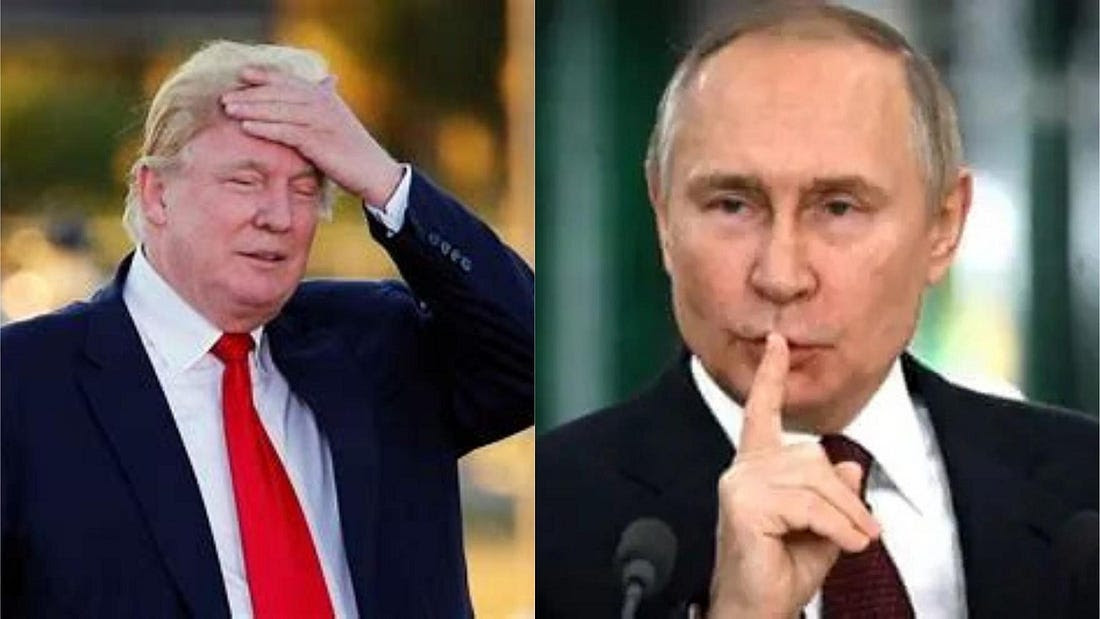
Ramifications from putin divorcing trump that you won't hear elsewhere from Cliff Schecter with Blue Amp (watch this space for more of our usual content later)
THE BLUE LETTER
Let
me walk you through something that no one in the mainstream press seems
to be talking about—but it's right there, smacking us painfully in the
face like Trump trying to pronounce “anonymous.”
Putin’s pissed.
No,
I mean like really pissed. Like “you were supposed to deliver Ukraine
on a silver platter and instead you gave me a drone strike humiliating
the Russian military 2,800 miles from Kyiv” kind of pissed.
And it’s not just frustration. It’s disappointment—which,
as every authoritarian toddler like Trump knows, is so much worse.
Because when Vlad’s disappointed? He starts shopping for a new American
President. Even if he doesn’t have the ability to do it with polonium
tea.
Let’s rewind, shall we? Trump rose to power with the full backing of Russia.
That’s not conjecture. That’s not a “Russia hoax.” That’s fact as
established in The Mueller Report, the Senate Intelligence Committee run
by a GOP Senator and something like 15-16 foreign intelligence
agencies. The only thing Trump changed in the 2016 GOP platform? The part where we’d defend Ukraine.
Gee,
I just can’t think who might have wanted that in there?!? Could it
possibly rhyme with Badamir Lootin? Everything else—the usual open
season for right-wing theocrats, supply-side snake handlers, those
concerned about ant-white racism and hedge fund vampires—remained the
same.
Fast
forward. Putin invades Ukraine expecting Trump, his loyal little
poodle, to take care of it. I mean, they installed him for a reason,
right? He had one job!
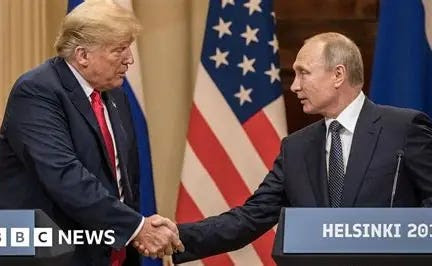
The bromance is more like Trump on his knees in Helsinki
Only
problem? Trump flamed out in 2020 because he ignored COVID, screwed
up the economy and is basically a schmuck. So Biden came in, and
Ukrainian President Zelensky—who Trump laughably tried to bully into
submission—turned out to be Churchillian.
He
not only outmaneuvering Trump tot the point where Trump got impeached
(one of two!). But also totally wrecked the
oft-topless-while-on-horseback Russian dictator with $47,000 worth of
drones and trucks—a serious Mission-Impossible kinda plan with some
serious Mission-Impossible-kinda courage.
Putin was left looking like a Bond villain with a receding hairline and no plan B. Elon Musk, basically.
So when Trump recently approved U.S. strikes on Iranian nuclear sites—after being told by Putin and Medvedev, in very clear language, not to, but just couldn’t help himself—well, now Trump was 0-2. (Not the mention the sanctions he hasn’t gotten removed).
And
that was the moment. Putin and his Lauren-Sanchez-Botox-regime mini-me,
Medvedevm came out publicly, accused the U.S. of launching an
“unprovoked war,” and made it crystal clear: Trump disobeyed orders.
Some more from Medvedev:
“Trump started a new war, and expects us to pretend it didn’t happen?”
Ruh
roh. You see, being smarter than Trump after chugging a bottle of
Stolichnaya, then still smarter after cracking it over his own head,
Putin knows Trump ran on “no new wars.” So he had Medy refute Trump’s
exact phrasing to fire up some piss and vinegar in a MAGA world already
beset by division over the bombing. With stalwart MAGAs such as MTG, Steve Bannon, Rand Paul, Tom Massie and Candace Owens furious.
And
if anyone knows what it looks like when someone hands you divorce
papers, that would be the serially married-yet-perpetually-porn-starred
Donald Trump. This time, however, the papers are coming from guy who
likes to break up with his boy-toys from 5th floor hotel windows.
Now,
I’m not saying Putin’s about to send Trump on a magic carpet ride sans
rug—he doesn’t want a nuclear war, after all. Though if you saw Trump’s
angry response, that “Putin better be careful,” well, let’s just say
that won’t go over well in Moscow.
And
Vlad has other weapons. Many, many cultural, economic, and
world-chaos-causing weapons. He’s also got options. And soon, he may just hold some auditions. Or Kremlin Casting Calls.
You’ve
got JD Vance, who’d probably crawl over MAGA hats with emptied Trump
diapers to polish Putin’s boots with a Made-in-China “Don’t Tread on Me”
flag. Tulsi Gabbard, who might as well be broadcasting direct from the
Kremlin basement. And for all we know, she might be.
There’s
Marjorie Taylor Greene, the Putin fangirl with a penchant for crazy
conspiracies, who when not dodging Rothschild spacer laser beams that
would make Flash Gordon jealous, get into her CrossFit fascism. And
don’t forget Elon Musk, who’s somewhere between Lex Luthor and your
emotionally stunted cousin who drinks diesel fuel thinks he’s a
genius because he read Atlas Shrugged once in college.
This
is the kind of palace intrigue that doesn’t show up on cable news
chyrons, because corporate news doesn’t like to share…news. But it's
real. And very much not difficult to put together if you have any
ability to connect dots, understand the language behind the language of
false diplomacy and can understand things like context and tonal change.
Putin
gave Trump his big chance. Sure, they knew he was nuts, but the kinda
nuts that Putin, and old KGB hand, knew could redound to their favor by
ripping this country apart emotionally. And Putin was right. But, he
also counted on Trump to execute. Big miscalculation there, Pootie.
So now the Kremlin just may be circling the field like a recruiter at a fascist football game.
And
look—this isn’t some lefty fantasy. I think this split likely helps
America a lot, but when it’s silly men with sillier egos and weapons of
mass destruction, there’s always danger. And Trump, often after a period
of blowing his shpadoinkle, comes back and apologizes, so this rupture
may be repaired.
Putin
doesn’t tend to be very big on forgiving disobedience. Sadly, in a
thoroughly corrupt GOP and propagandized Far Left, there are always more
marionettes to be had.
But, next time you hear Trump screaming that everyone’s out to get him—Iran,
Israel, every platypus, his ex-lawyers, the deep state, Tiffany, the
Hague—remember this: He’s not just unhinged. Well, he is unhinged,
actually, but not about this particular thing.
On this, he’s cornered. And
when a pathological narcissist like Trump—with something like 20 other
emotional challenges the DSM-5 specifically lays out—is cornered, he
lashes out at all those around him, and all those not around him.
That’s how wars can start. And that’s how democracies can fall.
If
Putin is truly done with Trump, and looking to install someone even
more obedient, we had better brace for what comes next—because there’s
no shortage of right-wing bootlickers in line to audition in front of
Putin, enter Stage Far Right.
THIS IS NOT A DRILL: call your electeds NOW and tell them VOTE NO on the "big beautiful bill"--YOUR LIFE DEPENDS ON IT!
Don't believe me--just read on. Check out these videos or, if you can't watch, just read the summaries I've put together for you here. This is no exaggeration and no joke--call your elected U.S. congresspeople and senators NOW and tell them VOTE NO on trump's budget bill because your life, and your loved ones' lives, depend on it. We still have time to stop it, so LET'S GO!
"Let's talk about how bad Trump's bill is...."
tillis, musk, and murkowski are NO friends to the working classes, but even they know how gawd-awful trump's "big beautiful bill" is. tillis knows that this corrupt AF bill will harm and kill North Carolinians. musk has financial interest in the bill--after musk and trump's lover's spat, electric vehicle provisions that would have benefited musk were cut. musk is right that that the bill disadvantages newer, cleaner industries in favor of dirty, obsolete industries, further damaging America's technological edge in favor of China. lisa murkowski pretended to buy a reprieve for Alaska so that she could pretend to justify voting for it, but that provision washed away in the Byrd Bath--sorry, Alaska, but you'll be suffering the most along with the rest of the red states if this project 2025 bill passes. republicans who insisted on pretending not to know what's in it are having it read to them in all its gory [sic], thanks to chuck schumer (who occasionally does something right). Everyone with more than one functioning neuron between their ears knows that this bill will disrupt, damage, and destroy the lives of hundreds of millions of us here in America. No one--not even the billionaires who expect to benefit the most from this nightmare of a bill will go unscathed by it. Never, ever forget: THIS IS EXACTLY WHAT maga VOTED FOR.
"Disabled + Elderly Americans Zip-Tied, Arrested for Protesting GOP's Plan to Gut Medicaid"
The billionaires see us as "useless eaters." Fascist regimes are always eugenicist--as trump, musk, and rfk, jr., show by their actions every single day. This is why they fully intend to murder us all--including if not especially elderly, disabled, pregnant people, and children. This is EXACTLY what maga voted for; whether it harms and kills them and their friends and families directly matters not because they'd gladly vote for their own demise again, every single time. I'm not exaggerating here.
"Let's talk about Trump's Medicaid cuts and cutting through the rhetoric...."
trump convinced about a third of the country to sign away their and their families' health care out of hatred and fear of a tiny percentage of the U.S. population--like the 12,000 transgender Americans who receive gender-affirming surgery every year and which is not covered by Medicaid in some states. trump convinced maga to hand over their earned benefits to parasitic billionaires who neither need nor earned them. trump literally told maga to vote for him and then drop dead, and maga groveled up to him and said, with tears in their eyes, "Sir! YES, SIR!"
"Elon goes SCORCHED EARTH, tries to KILL TRUMP’S TERM"
As we just said, musk isn't wrong in a single criticism of trump, the administration, or the big horrible bill. musk is in a position to do real damage to trump, and I'm here for it. A good reason to watch this video is the segment in which Bernie Sanders explains clearly and succinctly to joe rogan just how nightmarish and corrupt the big horrible bill is.
"Fact-checking 2 viral rumors about ICE: DoorDash and Tow Trucks"
Hope Core and Horror Core both lead to a lot of viral-but-false information. Although gig job employers, who frequently employ immigrants, may not verifiably be cooperating with ice, they are clearly doing NOTHING to protect their workers, especially immigrants--they protected their workers in trump's first term and have abandoned them this time. There ARE enough positive TRUE stories to share! Please fact check before sharing, friends. One thing we know is true is that icestapo is running around masked, kidnapping and terrorizing communities WITHOUT SHOWING ID OR WARRANTS. Angela warns not to tow or otherwise do anything to ice vehicles that might constitute a federal crime.
"Right Wingers FREAK OUT Over Mamdani NYC Win"
Hate costs maga everything they claim to hold dear, but they're so blinded by their hate that they can't even see what they're giving up for the sake of their hate, fear, shame, and rage. It's stupid: maga is terrified of a naturalized citizen who only wants to make everyone's lives better, but they're only too happy to put a felonious, treasonous, criminal, sadistic rapist hell-bent on burning America down to the ground--and them with it--in charge of the country. We ALL deserve better than trump--even maga deserves better than trump. I hope to high heaven they figure that out before they destroy us all.
"Republican Plot UNRAVELS As Widespread Hospital Collapse Unveiled In Medicaid Cuts"
Rural public hospitals will close if republicans cut Medicaid, just as we've been saying here. As John says, the knock-on effects would be disastrous.
"Trump Supporter RIPPED AWAY From Pregnant Wife In Unexpected ICE Consequences"
icestapo lies; fascist corporate media unquestioningly spreads the lies. Apparently, being a trump-supporting Iranian Christian with a visa--who even supported trump's illegal attack on Iran--in America is a crime...?
"SHOCK: RFK proposes the SAME 'MICROCHIPPING' they warned us about"
Every republican accusation is a confession--if not what they're doing then what they're horny to do.
TL;DR: bloated orange florida man dooms florida residents to death by hurricane by terminating weather satellite programs that predict storms and help inform people at risk when to evacuate. Um, have the day you voted for, I guess?
"Let's talk about the US being left out of a world trade club...."
This is a stark reminder to madame president* trump that she's not ruler of the world, and it's a stark reminder to the rest of us that trump has ceded our leadership in the world. As I've said before, trump and republicans' actions are indistinguishable from those of enemy agents hell-bent on destroying us.
"Elon Musk PLUMMETS In Public Disaster As Staggering Starlink Scheme Unravels"
leon skum's tesla stock never was tied to reality, so it's always done better than it should. and, as usual, republicans seek quid pro quo with musk by forcing starlink into disadvantaged areas. This would be terrible because it would let musk arbitrarily turn off Internet access to these communities just because he's on some weird ketamine high. maybe that's part of why musk is still so profoundly unpopular even "out" of politics.
"Trump And Vance Could Face Immediate Arrest After Criminal Charges"
Some immigrant communities are fighting back, and I'm here for it!
"Let's talk about Trump's high interest rates...."
The Fed sets interest rates for two reasons: to keep the economy growing and stable and to help decrease unemployment. trump's policies create such uncertainty and inflation that the Fed has no choice but to raise interest rates to counter all of trump's instability.
"Lets talk about US nukes in the UK...."
Our NATO partners are arming themselves AGAINST US. I mean, who knew that putting an unstable, erratic, stupid, ignorant, weak, cowardly, treasonous, felonious, serial rapist, sociopathic narcissist in charge of the United States could, oh, I dunno, destroy our reputation as a reliable, steady, reasonable partner in trading and defense across the entire world?
"Let's talk about Trump’s win, NATO, and Monkey Paws...."
Again, NATO is arming AGAINST US. And trump's "big deal" getting them to spend 5% of their GDP on "defense" is not limited to bombs and planes--it includes things like protecting against climate change, promoting food security for those in need, and many other humanitarian causes that trump and republicans loathe with a seething passion. Nice way to flip trump the bird, NATO!
"Republicans get DEVASTATING News. They're scrambling. Let's enjoy it."
republicans are freaking out because their murderous policies are being exposed to the American people, who strongly disapprove of them. Time to get out the popcorn and watch the murderous republican thugs scramble for their jobs, money, and power--as Angela says, if you think republicans in congress do NOT expect any more elections, "you haven't been paying attention" to how they're behaving (so quit being defeatist, m'kay?). Hopefully, Americans will finally learn and remember that republicans do nothing more reliably than screw them over, and hopefully Americans will vote more intelligently in coming elections.
"Trump PANICS As Idaho Firefighter SHOOTER’S Past Is REVEALED"
TL;DR: looks like yet another violent white male maga shooter. Yet again, it's trump supporters who have trump derangement syndrome and whose preferred solution to every problem is violence because trump encourages them to be their worst selves.
"23 Things to Love About Being Autistic"
One common theme: life is already so intense for autistic people that they have no need of drugs or alcohol--they get high on life with no external chemicals needed. No heroin, brain worms, road kill steaks, raw sewage skinny dips, or conspiracy theories needed. Suck on THAT, rfk, jr.!
"Why you definitely SHOULD NOT share this JD Vance meme"
MSNBC rarely posts deliberate comedy vice news, but this is absolute gold!! XD
trump's goons ZIP TIED ELDERLY AND DISABLED PEOPLE for protesting against losing Medicaid and Medicare...one lady in her wheelchair confronted the brownshirt thugs in their bulletproof vests and full military gear, saying, "I weigh 70 pounds, and I'M a threat to YOU?"
Democrats' top priority: serving the American public; republicans' top priority: selling out the American public so they can keep their money and power
Isn't it interesting that Democrats' cornerstone legislation gets Americans affordable health care, but republicans' cornerstone legislation kills Americans dead to enrich the already bloated, parasitic rich?
Definitely DON'T look up or share this meme of bald baby madame vice president* jessica donaldina vance
Here at Dot Calm's Page of Truth & Sedition, we don't dogpile on viral memes, oh no. We don't look them up, only to find that the trump administration's desperate attempts to suppress such memes only encourage world leaders to share them in official meetings and literally force U.S. lawmakers to share them more broadly when international students are denied entry to the U.S. because the entire administration is a bunch of spoiled rotten whiny sucky babies. Oh, no, we don't do that here. Nope. Not us.
moscow mitch mcconnell knows his days are numbered, so he wants to take as many of us 6' under with him as he possibly can.
He can't take his money with him any more than the dead Koch brother--the one who wanted all the money in the world?--can, so he thinks his only choice is to leave a legacy of cruelty, suffering, and preventable sickness and death.
In other words, he is a true republican to the core in the spirit of nixon, reagan, and everyone after them.
I wonder what happened to him and the rest of them to make them all so hateful, hurtful, and willfully destructive.
It must have been horrific.
And it behooves us all to rear our children to be better humans so that we can create the egalitarian, nurturing, compassionate society we all deserve.
We all deserve better than this--even republicans deserve better than this.
Cruel, heartless, soulless republicans are DETERMINED to punch down and KILL us all to enrich the useless, parasitic rich, but Democracy is holding!
"McConnell Goes FULL VILLAIN With Heartless Medicaid Remark"
republicans have been lusting to give YOUR paid benefits to the rich for decades now; thanks to Moscow mitch, they're on the brink of realizing their greatest wet dreams of harming and killing as many Americans as possible.
"They'll get over [losing their access to health care, watching their loved ones die from preventable causes, and suffering needlessly and dying from preventable causes themselves]."
"We're all going to die."
republicans do not understand that non-republicans are fully human with feelings, dreams, loves, and aspirations because republicans are not fully human themselves. Like trump, they are primitive humanoids but not fully human--they do not love. They are purely transactional; they only understand fear, hate, shame, money, and power. The "pro-life" republican party doesn't even understand what life is, let alone truly value it.
"Let's talk about Trump's causing Red States to lose rural healthcare...."
If trump and the republicans get their way, Medicaid cuts WILL close even more rural hospitals, nursing homes, and other health care facilities in red states, depriving everyone in those regions--whether they're on Medicaid or not--of access to health care. Live in a rural region? Hope you don't mind driving to the nearest city to deliver your baby or get your triple bypass surgery or get your broken arm set. republican "pro-life" is like republican "right to work": to them, "pro-life" is the right to die from preventable causes just as "right to work" is the right to be fired on the spot for no reason except the white male boss's greed. Misogyny and hate cost--not just money but American lives. FAFO, maga.
"Republicans just got stopped from doing 12 really really bad things"
A WOMAN--the Senate Parliamentarian--stopped republicans from devastating, decimating, and destroying us to their little black hearts' content.
"DOGE Morons Have Completely Destroyed Social Security System"
These are OUR PAID BENEFITS--we EARNED them. Billionaires DID NOT.
"Let's talk about Trump, MIGA, and Iranian Regime Change...."
madame president* trump and her sycophants are saying the quiet part out loud: they want regime change in Iran. Frankly, we need regime change HERE. republicans and their base apparently have worse long term memories than fleas if they've already forgotten how "well" regime change went for us in Afghanistan and the last time we tried it in Iran.
"Trump MELTS DOWN in AM as War Plan BACKFIRES HARD"
But post-menopausal women are "too emotional" to be President. Sure, Jan.
"Let's talk about Trump vs Massie: a message to republicans...."
For as hateful and hypocritical as massie is, at least he's been consistent in his isolationism and fiscal "policy." So trump wants to "tame" massie and other non-maga republicans into toeing the maga party line.
"Let's talk about congress trying to stop Trump on Iran...."
Of course madame president* trump shouldn't be able to unilaterally go to war on Iran. I'm old enough to remember that trump nuked President Obama's nuclear deal with Iran--which was working to dissuade Iran from building nuclear weapons exactly as intended--because trump is a racist. I'm old enough to remember that trump STARTED this fire. trump treating Russian asset gabbard--who, ironically, was correct about Iran's nuclear program NOT being a threat to the U.S.--as an idiot only goes to show that even idiot trump knows that every trump appointee is also an idiot. It's also nuts that miss trump telegraphed her intent to bomb Iran so far in advance that Iran had ample time to relocate their fissile materials and experts. Like, what did trump expect?
"Let's talk about Iran, Trump, and stability...."
Belle of the Ranch discusses how we got here, including trump shredding President Obama's nuclear deal with Iran and its long term effects, which we're all suffering now. Did you know that President Biden had a 24/7 surveillance/diplomacy effort to prevent an Israel-Iran conflict that could lead to regional conflict? Of course he did! And, of course, trump nuked that, too, so here we all are.
"Kristi Noem HOSPITALIZED after visiting biohazard lab with RFK Jr."
What happened? Did her maga lip implants implode? Did she shake rfk, jr.'s hand after he swam in Rock Creek? Or did she actually catch something from the problematic biohazard lab at Ft. Detrick? Or did she really have an allergic reaction? In any case, the cover-up is typical of trump administrations. WHAT ARE THEY AFRAID OF?
"Elon has NIGHT TANTRUM after HIS OWN APP ROASTS HIM"
This is HILARIOUS--leon skum's own AI app, "Grok," fact-checks him and maga. We all know that reality has a liberal bias. Oh, the deliciousness of maga tears! Cry on, maga! Facts don't care about your feelings.
"They tell us it's good to suffer. While they live in luxury."
republicans love to live it up at the expense of the rest of us, especially women and children. For all of his misogyny, Cristopher Hitchens called out this hypocrisy in Mother Theresa, who lauded poverty as a good and who actively aggravated the suffering of the poor and the sick she pretended to help, all while enjoying vast wealth and the best Western medical care money could buy.
"Military Leaders HID Strike Plans From Trump Because They Didn't Trust Him"
Of course the military hid their actual plans because of course trump would spill the beans. trump is the biggest threat to national security--even the military admits it. The Rosenbergs were executed for less.
"Let's talk about Iran's response, Trump, and your questions...."
As always, like all republicans, madame president* trump only sees her own actions as far as the end of her nose--republicans never seem to learn that their actions have consequences they may not like. Kinda like maga voting for decades for leopards to eat THEIR faces and then being shocked when it actually happens TO THEM.
"Schiff Takes to MSNBC, Blasts Trump for Hiding Key Information from Congress
The trump administration is the least transparent of any in American history, and that is criminal--as is what they are doing to the brown people who work here, who pay more taxes and receive fewer benefits than billionaires, who bring up their children to serve their country unlike republicans do, and who do NOT have rap sheets like trump does.
"Let's talk about Trump’s strike not working...."
madame president* trump's Iran strike created way more risk than it ever mitigated. trump's Iran nuclear policy has only fomented Iran's will to build nuclear bombs. trump started a fire she's too incompetent, too stupid, and too much of a chicken TACO to be able or willing to put out.
"Trump's Policies Have Bankrupted ICE"
The icestapo is apparently $1B in the hole. GOOD. Unfortunately, they're still brutalizing brown elderly military parents and disappearing them...and trump could do even worse by stealing from helpful agencies to fund harmful ones like the icestapo because we all know that republicans lust for the right to steal from you and poison your food, air, and water....
"PISSED OFF Billionaire Gets BRUTAL SURPRISE at Wedding"
I love this for bezos. Everyone needs to keep reminding him that, of all people, he can afford to pay his fair share of taxes. What's odd about matt gaetz's texts is that--I'm shocked...shocked, I tell you--he's actually...ulp...correct about war criminal w's invasion of Iraq, Iran's being months away from nuclear weapons for decades, and Democrats' having better policies about war and nukes. Hm.
"Will you play a game with me?"
Who is this masked man kidnapping and disappearing brown people from their homes and their workplaces: icestapo? Law enforcement? J6'er? White supremacist? A nazi by any other name still stinks to high heaven and deserves to go to hell.
"Congress, Now More Than Ever, We Need Your Cowardice"
From The Onion: a message that every republican and that milquetoast Democrats like chuck schumer and mark warner can really get behind! And yes, The Onion sent their hilarious-but-horrifically-accurate open letter to every member of Congress. Alas, what should be parody has become our daily news.
"Voter's Remorse Helpline: Bombing Iran Edition"
Hilarious!
From Tabitha Speaks Politics: "Palantir just partnered with OpenAI. That’s Peter Thiel + military surveillance + ChatGPT… all in one pipeline. If Trump & Vance win, this isn’t just tech—it’s infrastructure for authoritarianism."
Like Hillary before her, Kamala was right about EVERYTHING.